Founder notes
Build notes from a product trying to stay honest
Public essays adapted from StartupAI source notes on evidence, founder authority, and decision quality.
This archive keeps the product judgments behind StartupAI visible without exposing internal implementation detail or pretending source notes were public publication dates.
Why this page exists
Founder notes are here to explain why the product is being built this way, where generic AI falls short, and what the current validation workflow is trying to improve.
Founder judgment
Essays explain the decision founders should understand, not the machinery behind it.
Source-date semantics
Cards show the date of the underlying source material, not fake publication history.
Evidence discipline
Every note reinforces the boundary between belief, evidence, and founder authority.
Featured note
Start with the decision that made onboarding sharper
The featured note explains why StartupAI asks founders for less upfront, then uses reviewed discovery work to build a stronger brief.
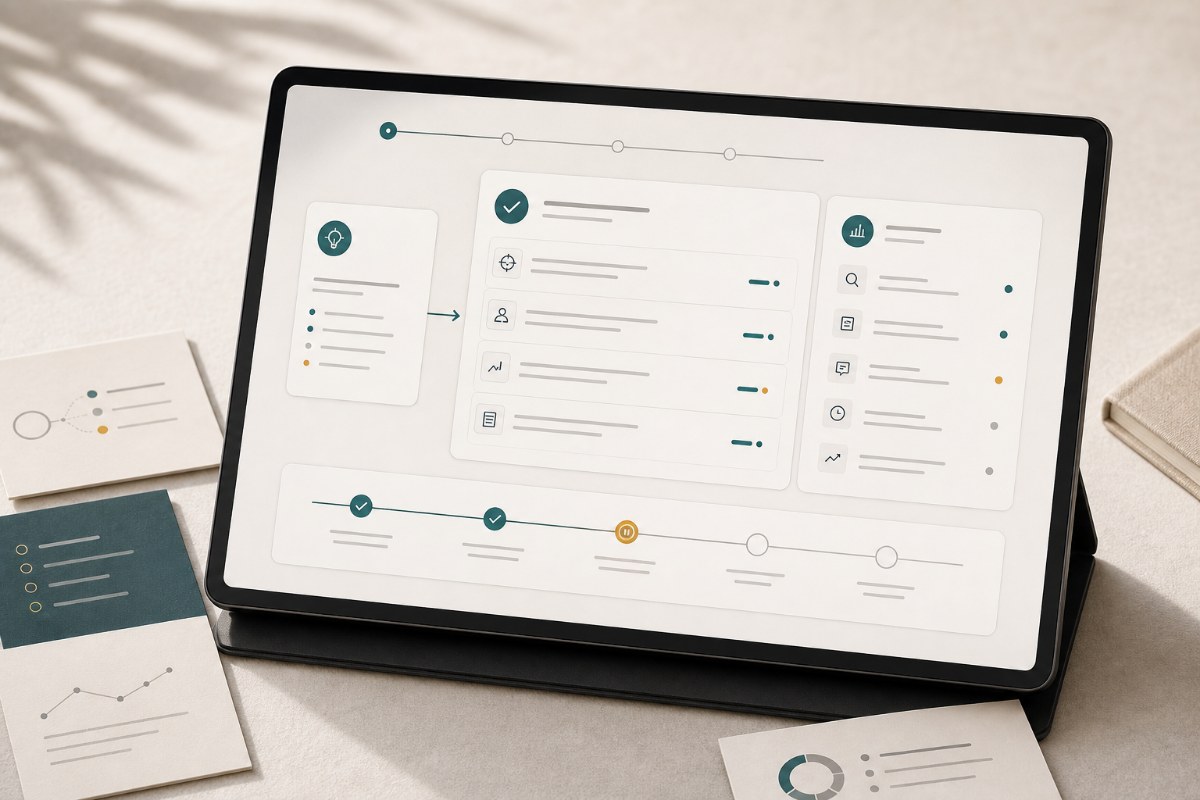
We ask for less on purpose
Good onboarding should remove guesswork — not make you invent the research the product is supposed to do for you.
Archive
Source-derived notes for founder decision quality
Twelve public essays adapted from StartupAI decision, architecture, and concept notes. Legacy launch posts stay routable, but this archive now promotes the methodology.

Most software brags about speed. We built ours to stop. When a validation step is about to change your customer, your direction, or your spend, StartupAI doesn't roll on to the next screen — it pauses, shows you what it found, and waits for you to decide. Here is why a deliberate pause is the most useful thing a validation tool can do.
Decision gates - ADR-002
Read note
Early on, we ran validation as a conversation — and learned the hard way that a smooth chat can hide a fragile memory. Refresh the page and the context disappears. We rebuilt it so the record, not the chat, is the source of truth. Here is why that boring-sounding decision is what makes a recommendation trustworthy.
Evidence memory - ADR-005
Read note
We used to open with a half-hour interview — a multi-step conversation that walked you through your problem, customer, solution, market, and competition before you had tested anything. We deleted it. Now StartupAI asks one question: what is your idea? I want to explain why we made onboarding ask for less, because it is not a convenience — it is an argument about where the work belongs.
Founder onboarding - ADR-006
Read note
StartupAI is really two things wearing one interface: the workspace where you review briefs, approve plans, and make calls, and the engine that decides what your evidence means. We keep them deliberately separate — and that boundary is doing more for your trust than any single feature. Here is the argument for it.
Product boundaries - ADR-007
Read note
When you test a value proposition, you want the market reacting to your promise — not to a broken layout. So we do not ask AI to invent the whole page. It writes the words; proven structure holds the shape. Here is why that division of labor is what makes a test mean something.
Validation assets - ADR-003
Read note
Early in building StartupAI, our system once handed back a polished, confident, completely made-up customer profile — one that had nothing to do with what the founder actually entered. That moment set a rule we now build around: a recommendation is only as trustworthy as the line between what was observed and what was invented. Here is how we keep that line visible.
Evidence integrity - ADR-010
Read note
Validation keeps producing moments that look like software steps but are really decisions: change the segment, run a different test, spend more, pivot. We built StartupAI so a recommendation can never quietly become an action. At those moments, it stops and hands you the pen. Here is why approval is a feature, not a formality.
Founder authority - ADR-014
Read note
One big AI report feels satisfying: a customer profile, a value proposition, a recommendation, all in one go. The trouble is every layer leans on the one before it, so a wrong brief quietly becomes a wrong conclusion. We broke discovery into a chain of reviewed steps instead. Here is why that is more trustworthy than a verdict.
Discovery workflow - ADR-015
Read note
Most validation tools are strong at the two ends — they will make you a plan and they will score your results. The hard part is the middle: actually getting real evidence out of the world. We decided not to hand you a plan and a grade and leave you alone for the part that matters most. Here is why.
Evidence collection - ADR-017
Read note
We are rebuilding the engine that runs validation under the hood — for tighter control over reliability, cost, and what we can see when something goes wrong. The rule we set for ourselves: you should not feel it. Same workflow, same review points, same evidence rules. Here is why “change the engine, keep the promise” is the discipline that matters.
Runtime evolution - ADR-020
Read note
Two founders with the same idea can need completely different validation plans, because they have completely different tools, data, and ways to reach customers. StartupAI is built to meet your real stack where it is — and to never confuse “connected a tool” with “proved something.” Here is why that distinction makes the plan more honest and more practical.
Founder context - ADR-021
Read note
We use a phrase internally, “Innovation Physics,” and it is only useful if it means one thing: evidence beats intuition. The moment it starts to sound like we have discovered the laws of startups — exact cutoffs that decide your fate — it becomes a lie with decimal points. So let me be clear about what the numbers are and are not.
Decision quality - ADR-022 + Innovation Physics concept note
Read note